Development
Every Spell Leaves a Scar
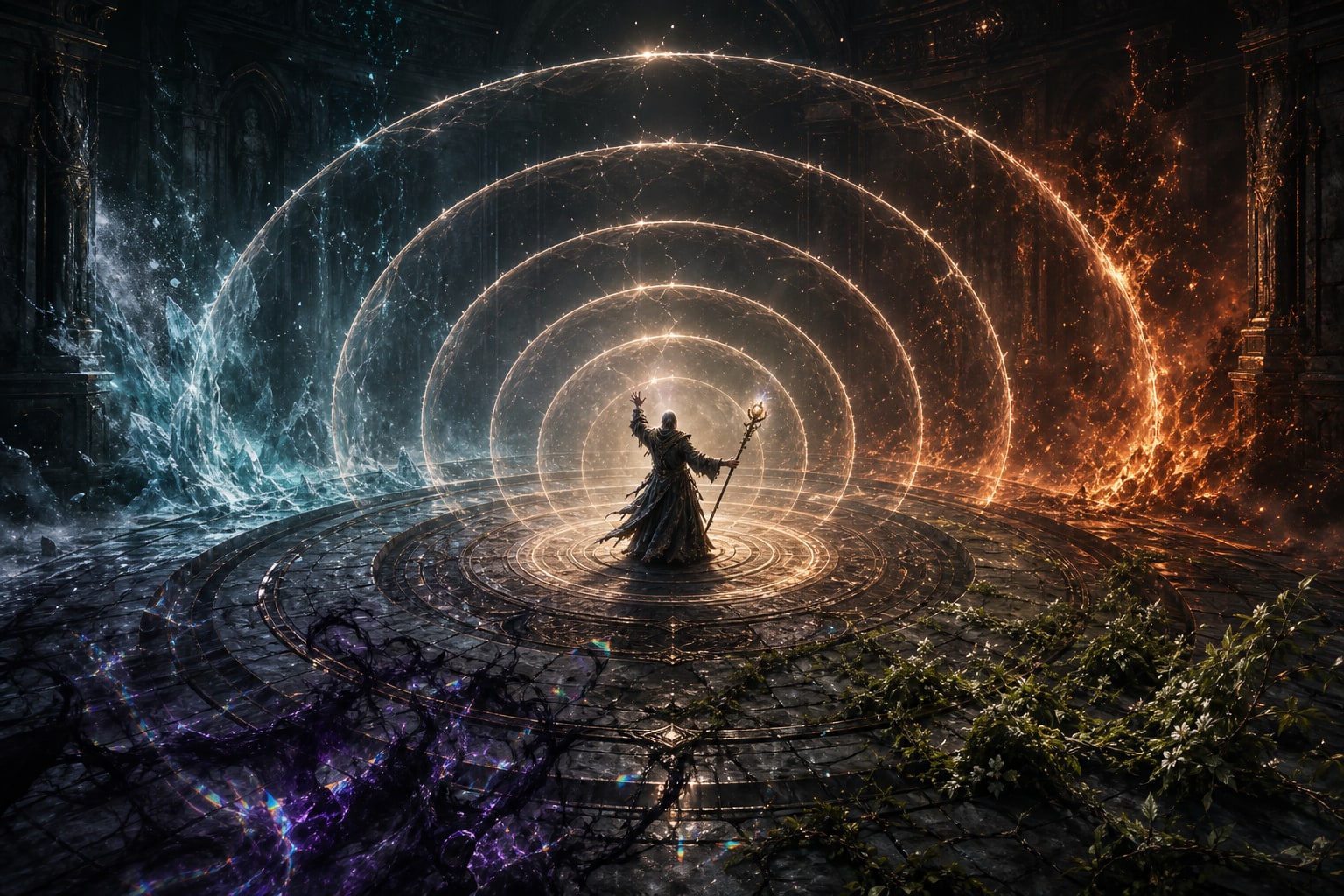
A ninth-circle spell should not enter a room like a candle being lit.
The seven-phase casting-visuals project gave magic a language equal to its mechanics. The system now decorates the ordinary spell pipeline with five families of feedback while preserving the older messages as a safe fallback.
Every school speaks differently
Abjuration, Conjuration, Divination, Enchantment, Evocation, Illusion, Necromancy, and Transmutation can use distinct start and completion imagery. The message also respects whether the target is the caster, another creature, an object, or the room itself.
Every caster has a hand
A Wizard’s measured precision need not resemble a Sorcerer’s instinct or a Cleric’s invocation. Class casting styles change the character of the action without changing the spell’s result. Metamagic leaves its own signature too: a quickened spell, a maximized spell, or a silent working can look meaningfully different.
Power changes the room
Long casts can move through five escalating progress stages rather than repeating one generic line. Casters and observers receive separate perspectives. The environment then reacts according to spell circle: subtle at circles one through three, forceful at four through six, and dramatic at seven through nine.
The implementation is bounds-checked throughout. If a school, target, or message slot has no enhanced entry, the original spellcasting text still carries the action. Interruption, concentration, item use, Alchemist extracts, and Psionic manifestations continue through the same underlying machinery.
Magic already changed hit points, position, weather, memory, and death. From November 2025 onward, it also changed the air in the room—and made sure everyone present could feel the difference.