Development
The Artificer’s Age: Devices, Golems, and Mooncraft
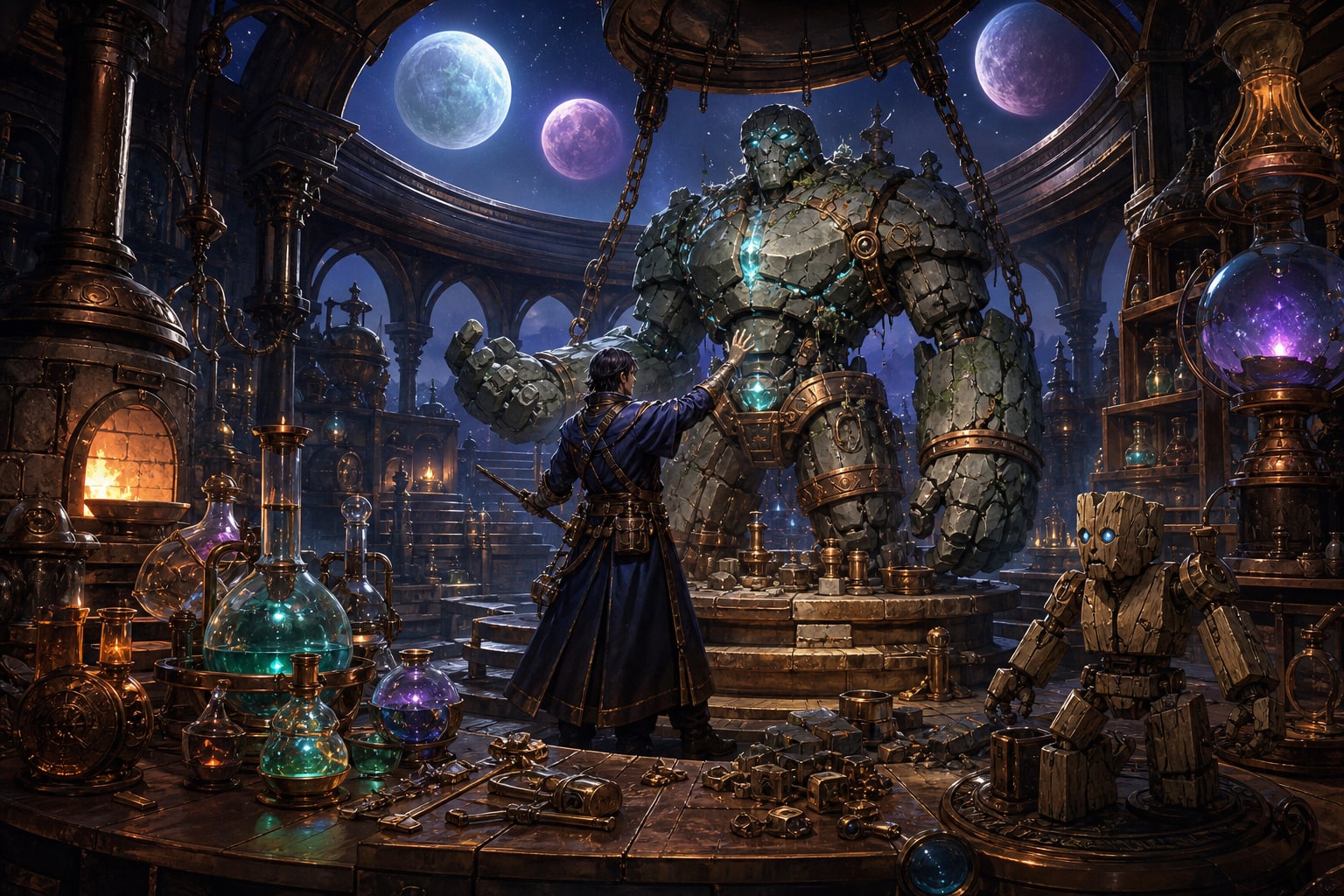
The Artificer does not ask whether magic can be held. The Artificer asks which tool will hold it best.
Work that began in September matured into a complete class definition with its own saves, progression, feats, abilities, and item-creation identity. Jack of All Trades, Artificer’s Lore, Weird Science, Elbow Grease, Salvage, Metamagic Science, and a ladder of magical crafting feats gave the class several ways to solve a problem before drawing a weapon.
Magic in a device
The device workflow lets Artificers invent, inspect, use, repair, and recharge stored magic. Running a device beyond its remaining charges becomes a deliberate risk, with increasing difficulty rather than a silent failure. Charges, cooldowns, destruction, repair, and metamagic interactions were refined across several passes.
Spellcasters also gained brew for potions. Salvage turned old gear back into useful value. Supply orders, crafting stations, harvesting tools, and artisan points connected the class to the broader economy instead of leaving it in a private crafting menu.
Constructing a companion
Wood, stone, and iron golems became craftable milestones. They can be created, repaired, and taught a growing set of construct abilities; wood golems accept varied wood types, while the iron form sits at the epic end of the path.
Small spells, moving heavens
A full cantrip layer brought direct damage, stabilization, roots, virtue, Arcane Mark, Detect Poison, and other zero-circle magic into class lists and spell displays. At the opposite scale, Dragonlance’s moons began affecting arcane casters through configurable phases.
The Artificer’s Age was not just a class release. It was the point where crafting, consumables, companions, spell lists, supply work, and the sky itself began sharing one set of tools.