Development
The Foundry and the Far Road
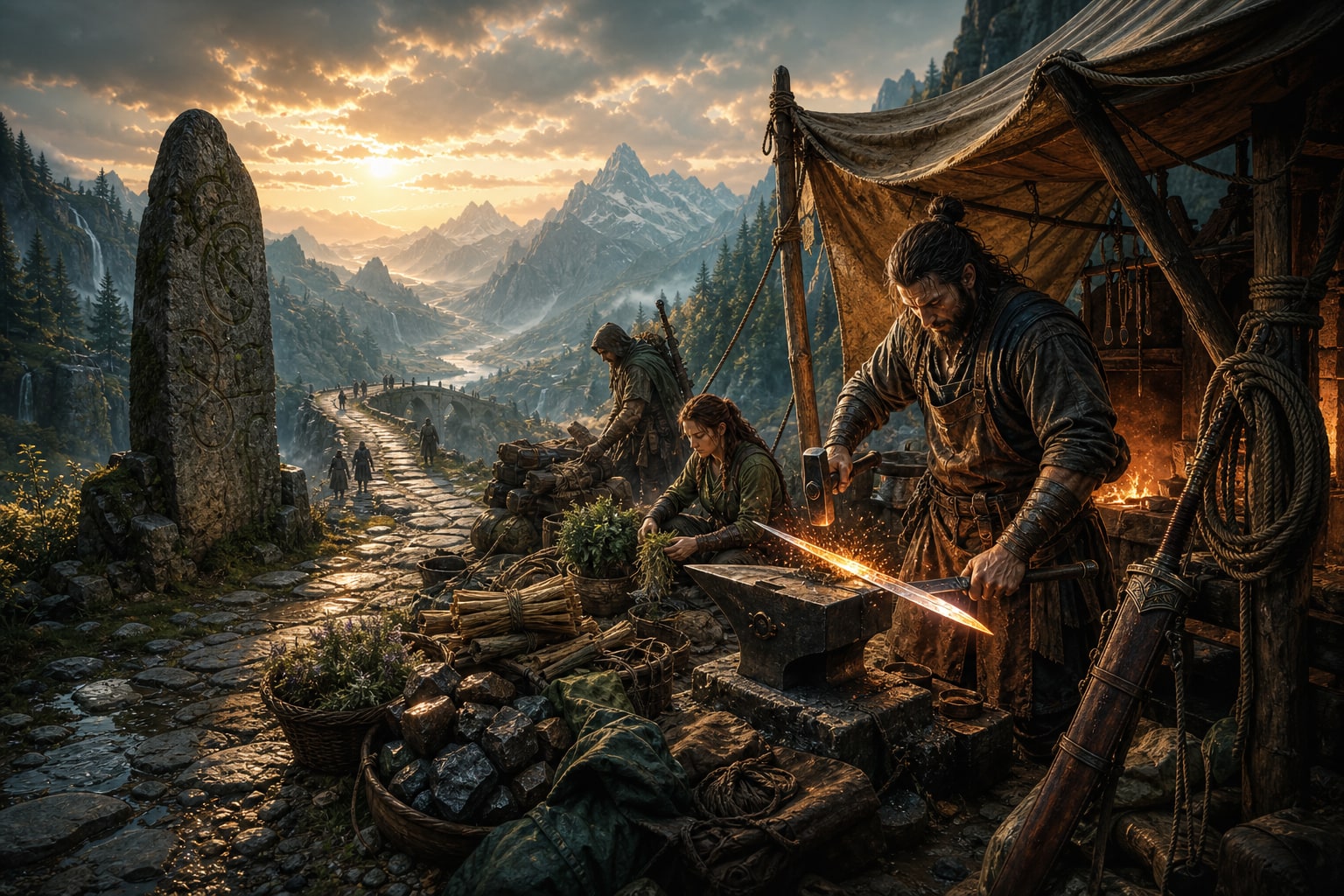
The forge and the road solve opposite problems. One asks what you can make from the world. The other asks whether you can reach the place where it grows.
Across the first half of 2025, the new crafting system moved from recipes and harvest nodes into a working foundation. Dedicated instruments, material handling, breakability, level adjustment, two-handed weapon scaling, and a growing recipe library gave builders and players a shared grammar for making equipment instead of only finding it.
The wilderness becomes legible
Landmarks and walkto turned known locations into usable routes. Landmark output gained distance in rooms. Walk-to travel learned when to stop—combat, blocked movement, or another condition that made automation unsafe. Shared room-distance functions gave future missions, freight, and navigation systems a reliable measure.
Climbing and swimming received deeper checks, including falls, damage, and ways to avoid the worst outcome. Slow Fall was tuned to fit that movement model. Treasure chests explained themselves when examined, and ordinary get and put commands could work with the virtual bag system.
Equipment gains a silhouette
Right and left ankle slots, a sheath slot, and the sheath and draw commands expanded how characters carried and displayed gear. Newbie equipment was rebuilt. Random treasure reached face, shoulder, eye, ear, and ankle locations, while crafted and generated objects began obeying the same bonus guidelines.
Those guidelines moved directly into object editing. Builders could see how many apply types belonged on a wear slot, review recommended ranges, generate compliant random bonuses, and use wearapplies or wearlocations instead of hunting through an external document.
The foundry gave the road a reason. The road gave the foundry materials. Together they laid the practical foundation for Artificers, supply orders, crafting talents, trade, and every later system that needed the wilderness to be more than empty distance.